|
|
|
|
|||||||||||||||||||||||||||||||
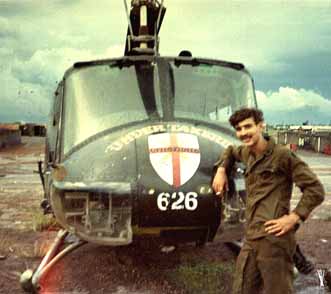
Above is Frank Drinkwine, The first and last Team Leader. Below is Mike, who came on the team with Frank after I got into a bit of 'trouble' in July.
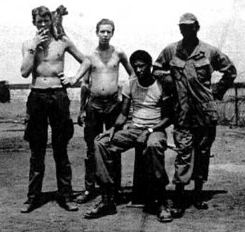
Mike was Frank's Door Gunner aboard 626 'The Undertaker'. Below is Me, 'Tex' Carter, 'Bro Slim', and Willy Maronie. When this picture was taken I was the Team Leader.
|
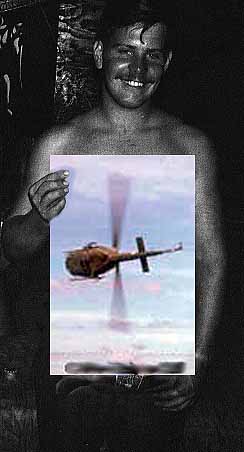
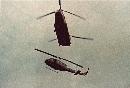
April 1971, The Pathfinders of the 75th Rangers in Cu Chi were standing down and going home. Their departure meant that a necessary job for local Aviation units would have to be filled from within their ranks. Before they left the Pathfinders taught five men from the 187th AHC the tricks of the trade for downed aircraft recovery. We were Crew Chiefs, Door Gunners, Engineers, and Supply Clerks. Now we made up a Recovery Team that would work in Vietnam and Cambodia. The sling job shown here was done by maintenance folks on a DX'd bird. (DX=beyond repair) Our team did it a little different. We had bags that would slip quickly on the ends of the rotor tips. The bags had straps attached with quick fasteners on the ends that would hook to the skids in front and fasten under the tail boom in the back. The most time consuming job was mine on top. I had to wrap a strap in a figure 8 back and forth on the rotor hub, then fasten the lift strap with a clevis where the loops crossed over the 'Jesus nut'. The lift strap had a donut already attached on the other end. I'd hold the donut up as high as I could reach and the Chinook would hover down over me until I could flip it onto their hook. You had to be careful because the metal hook would have a tremendous static electric charge built up from the rotor blades moving through the air. If you touched it, it would knock you down. Another hazard of the job was that the hooks were electronically controlled and would sometimes open on their own, dropping their load. That's why it was important to me to get the hell out of Dodge ASAP. An obvious risk was that there was a bounty on the heads of all Airmen, and lots of booty usually aboard choppers. Everybody that saw the ship go down would converge on it and often get there before we did. Our first priority was to get the passengers and crew out if they weren't already gone. Part of our gear was first-aide and body bags. Second priority was to sling the bird out if possible. If not we carried 'Willy Pete' grenades, and would toss one in the Avionics compartment in the nose and one or two between the pilots' seats. If possible they wanted us to get a 'black box' out of the avionics compartment. If we were working under fire it was get the whole helicopter or burn it though. Most of the rounds we took were from long range from cover. Sir Charles feared our gunships and seldom approached too close in force. Lucky for us they didn't know that our gunships, the 'RatPack' was usually heavily engaged elsewhere and seldom around. 'PipeSmoke' sometimes brought his own. It was a Chinook gunship; call-sign 'GunSmoke'.  |
|||||||||||||||||||||||||||||||